
Coconut Shell Charcoal
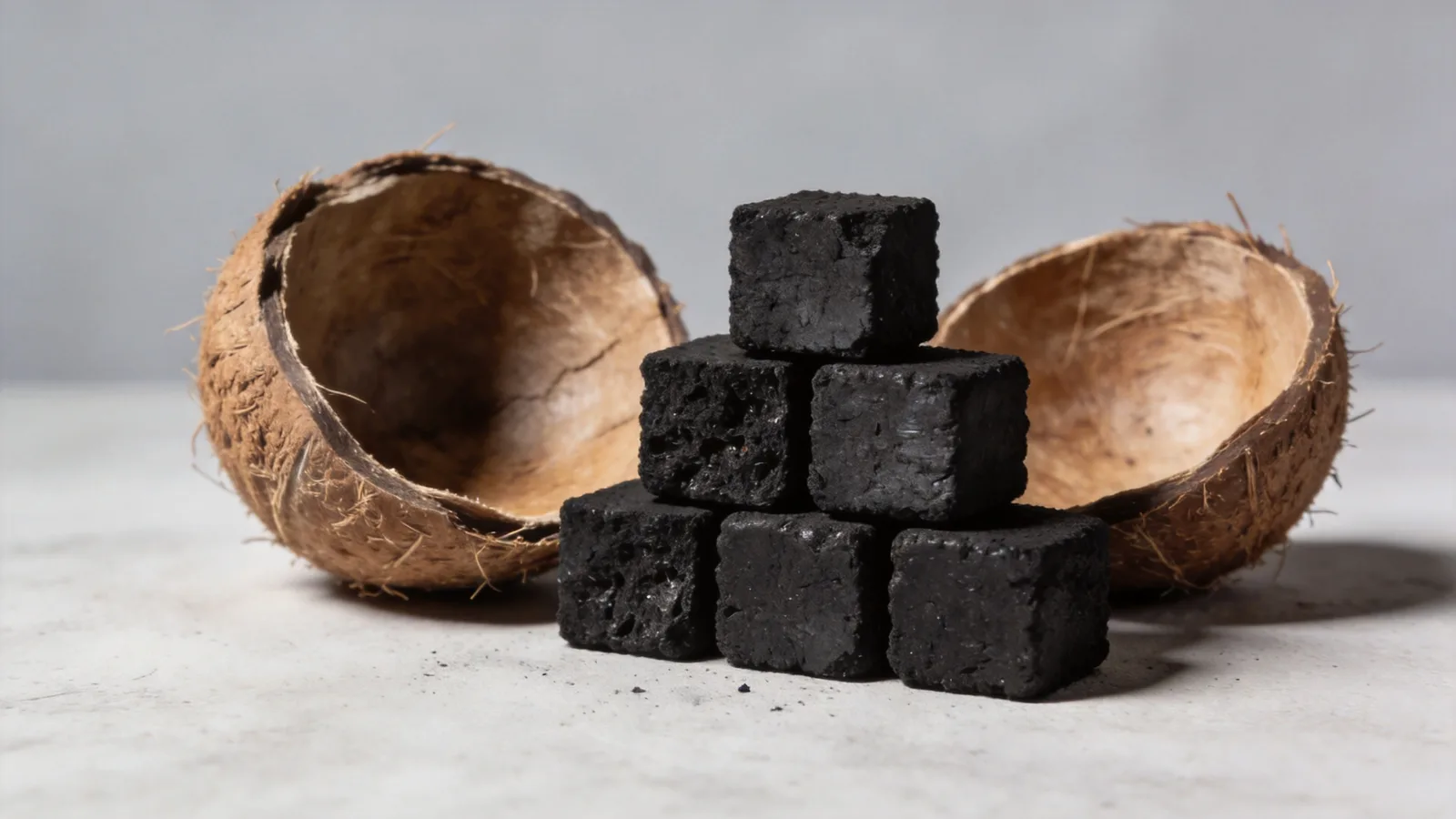
Natural charcoal made from coconut shells — the core raw material for hookah and BBQ charcoal. Valued for density, low ash and long burn time relative to wood-based charcoal.
What It Is
Coconut shell charcoal is produced by carbonizing coconut shells — the hard, dense husk of the coconut fruit — in a low-oxygen environment. The resulting charcoal is compressed into cubes or other shapes for use in hookah, shisha and grilling.
The raw-material choice matters for buyers: coconut shell is denser than most wood charcoal, which generally translates to longer burn time and less ash by mass. These properties are what make it the standard choice for hookah charcoal.
Specifications We Evaluate
| Specification | What It Tells the Buyer |
|---|---|
| Size (cube) | Cube dimensions — commonly 25mm, 26mm or 27mm — and dimensional tolerance. |
| Ash content | Residue left after combustion; lower ash means less cleanup and a cleaner session. |
| Moisture | Affects how easily the charcoal lights and how consistently it burns. |
| Fixed carbon | Indicates energy density and contributes to burn time. |
| Volatile matter | Affects ignition behaviour and smoke during lighting. |
| Burning time | How long a piece sustains usable heat under controlled conditions. |
| Ignition time | How quickly the charcoal reaches full glow. |
Specific product entries for coconut shell charcoal — with verified numeric specifications, MOQ and manufacturer — are published in the product database once supplier verification completes. We do not publish unverified figures.
Specification Context
One product record in the database carries declared values for coconut shell charcoal — the 25 mm natural coconut shell hookah cube. The figures below are reproduced for context and are supplier-declared, not independently verified by Charcoal Hub.
| Parameter | Declared value | Method cited |
|---|---|---|
| Fixed carbon | ≥ 80% | ASTM D3172 |
| Volatile matter | ≤ 12% | ASTM D3175 |
| Ash content | ≤ 3.5% (typical 3.0%) | ASTM D3174 |
| Moisture | ≤ 5% | ASTM D3173 |
| Sulphur | ≤ 0.1% | ASTM D4239 |
| Burning time | ~60 min (claims up to 120 min) | Condition-dependent — no universal standard |
| Ignition time | 8–12 min | Supplier-declared |
Buyer Checklist
- Method and basis. Ask which method produced each figure (ASTM / ISO / GB) and whether it is reported dry or as-received.
- Batch linkage. Confirm which batch, sample and date each number describes — a figure without a batch is not enforceable.
- Raw report. Request the laboratory report itself, not a summary PDF or a marketing datasheet.
- Moisture at origin. Check moisture at origin and again on arrival — charcoal is hygroscopic and shifts in transit.
- Size and tolerance. Confirm the nominal size class and its tolerance, and verify with calipers on a sample.
- Feedstock purity. If odour or smoke matters, confirm single-source coconut shell versus a blend.
- Acceptance clause. Agree the sampling procedure and the remedy for an out-of-spec arrival before ordering.
Verification Status
No coconut shell charcoal product has yet been independently verified by Charcoal Hub. Published figures are supplier-declared and labelled as such; no figure is presented as an established fact. Test reports, when attributable and verified, will be published on the testing sub-site.
Related
25 mm product record data
Supplier-declared specification values with their source and status.
Specification methodology data
What ash, moisture and fixed carbon measure and how they are determined.
Test methodology testing
How each parameter is measured under public standards, with limitations.
How to compare knowledge
A buyer guide to reading and comparing supplier spec sheets.
What ash content means knowledge
Why low ash matters and how the metric is tested.
Request samples
Verify a batch yourself before committing to volume.