
Testing & Quality
Transparent testing is the foundation of a trustworthy charcoal supply. Every data point we report is labeled by its source — third-party laboratory, supplier-provided, or not yet verified.
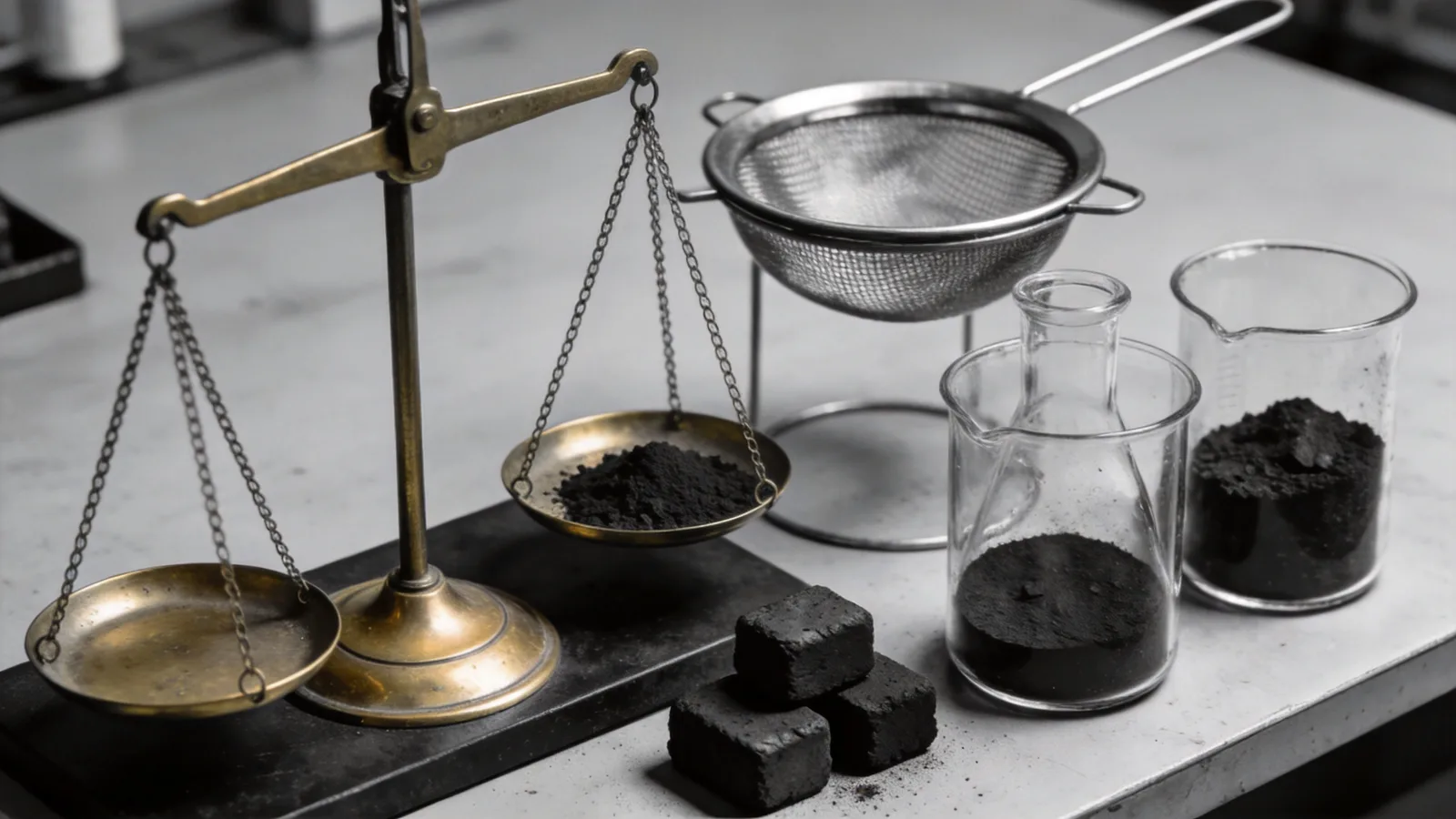
The Six Core Metrics
Six measurements cover most of what appears on a charcoal datasheet. Each is a public methodology, explained in detail on the testing sub-site.
Ash content
Residue after combustion — a key hookah quality signal.
Moisture
Affects ignition and burn consistency.
Fixed carbon
Drives energy density and burn quality.
Volatile matter
Affects ignition and smoke.
Burning time
Session duration under controlled conditions.
Size tolerance
Dimensional consistency across a batch.
How to Read a Test Figure
- Ash content — the non-combustible mineral residue; lower generally means less residue in the bowl. Ask for the method and the basis (dry vs as-received).
- Moisture — water weight you pay to ship; higher moisture makes charcoal harder to light. Ask for the oven-dry method and the basis.
- Fixed carbon — the solid carbon fraction, calculated by difference, not measured directly. Check it reconciles with moisture, volatile matter and ash.
- Volatile matter — the quick-releasing fraction; drives ignition speed and start-up smoke.
- Burning time — has no universal standard; the test conditions must travel with the figure or it is not comparable.
- Size tolerance — permitted dimensional deviation from the nominal size; define it in the purchase spec.
A number without a stated method and basis is a marketing figure, not a specification you can enforce.
Data Source Transparency
- Third-party laboratory testing — clearly labeled as such.
- Supplier-provided test data — clearly labeled as supplier reported, never presented as independent fact.
- Not yet available — we do not claim testing capabilities we do not yet have.